Wedding Seating Chart Etiquette
Who sits where at the reception, from the head table and the parents’ table to plus-ones, children and exes, and how to list names on the chart.
Seating etiquette comes down to one idea: the people closest to you sit closest to you, and every guest sits with someone they’ll enjoy. The details below are traditions, not rules. Change them to fit your families.
Do you need a seating chart?
- Plated dinner: yes, with at least an assigned table and usually an assigned seat, so servers know who ordered what.
- Buffet or family style: assigned tables help, so guests have somewhere to come back to, but seats can be free.
- Cocktail reception or a small buffet: optional.
- Make one anyway if your parents are divorced, some guests shouldn’t sit together, or many guests won’t know anyone. A chart takes the awkward choices away from them.
Who sits where
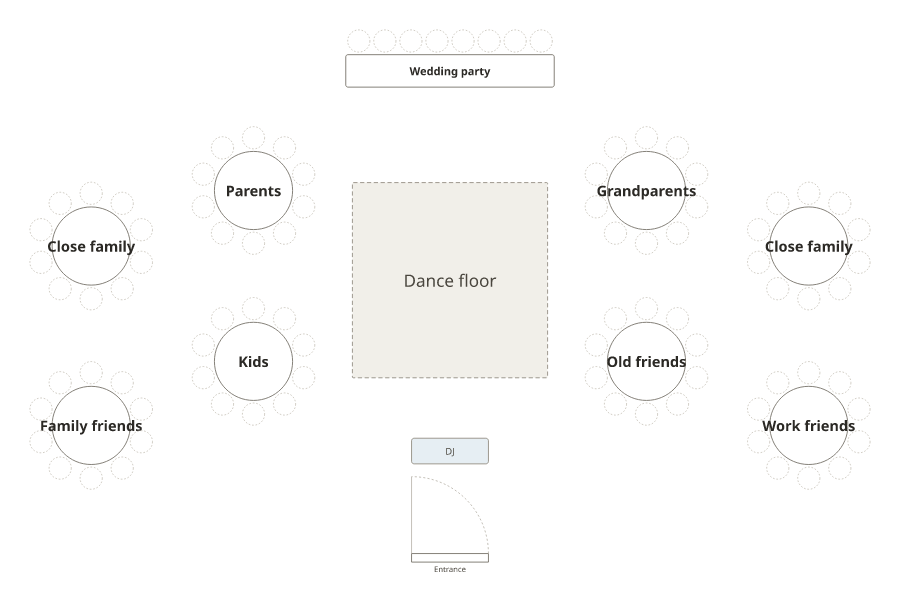
Work outward from the head table. Parents and grandparents get the tables nearest to you, then close family, then friends and colleagues. Seat the children’s table near their parents, and keep the dance floor and the DJ in front of the head table so the people you care about most have the best view.
The head table
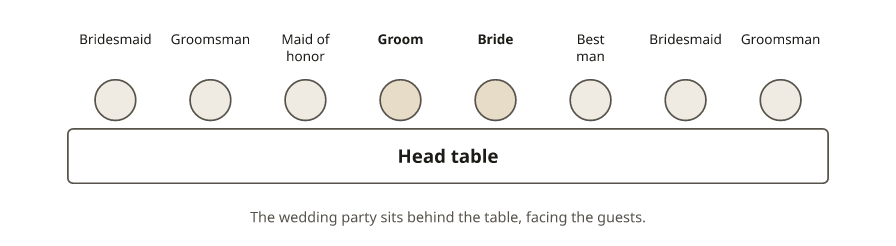
- The traditional head table is one long table with the wedding party seated on one side, facing the guests, and the couple in the middle. The two closest attendants sit beside the couple, and the rest alternate outward.
- Every wedding party is different. The same idea works for any couple: you in the middle, your closest people beside you.
- A king’s table is a larger version: one long table where the couple sits with the wedding party and, usually, their partners, often on both sides.
- A sweetheart table seats just the two of you. The wedding party then sits with their partners at tables nearby.
- Partners of the wedding party who aren’t at the head table should sit together at a good table close by, not scattered among strangers.
Where parents sit
- One parents’ table nearest the head table, with both sets of parents, often with the grandparents and the officiant.
- Two tables of honor, one for each family, each hosted by a set of parents with their own relatives and friends. This suits large families and families who don’t know each other well.
- At the head table, at a small wedding, sometimes with the couple in the middle and parents at the ends.
- Divorced parents: give each parent their own table of honor with their own partner and family, and make sure both are equally close to the head table. Nobody should feel they got the lesser seat.
Grandparents, the officiant and older guests
- Grandparents at the parents’ table if there’s room; otherwise at the next table over, close to you.
- The officiant and their partner are usually invited to the reception and seated with the parents or close family.
- Older guests away from the speakers, with an easy path to the restrooms. Seat anyone who uses a wheelchair or walker on a clear route from the entrance; our reception table layout guide covers spacing and aisles.
Plus-ones, children, singles and exes
- Plus-ones always sit with the guest who brought them.
- Children under school age sit with their parents. Older children can share a kids’ table near their parents, with something to do.
- Guests on their own do best with people they share something with: work, a hobby, a hometown. Avoid an obvious “singles table”.
- Exes and relatives who don’t get on go at different tables, ideally out of each other’s line of sight, and both at good tables.
- Vendors who are eating with you (photographer, videographer, planner) can have a small table near the action.
Remembering loved ones
Many couples honor a parent or grandparent who has died with a reserved seat: a chair at the ceremony with a flower, a photo or a small sign, or a memorial table with photos near the entrance to the reception. Talk to the family closest to that person first, and keep it simple.
Names on the chart
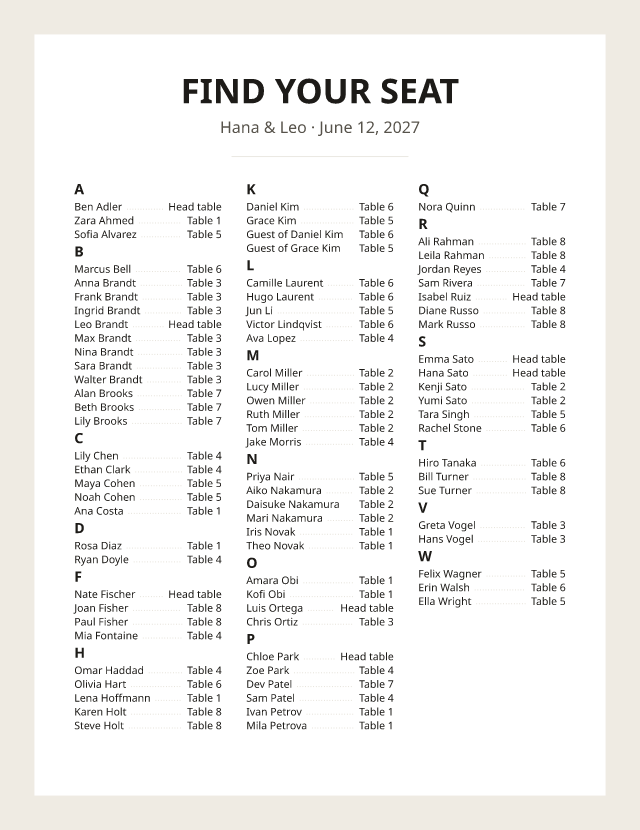
- Alphabetical or by table? By table for a smaller wedding; alphabetical for a larger one. A common rule of thumb is to switch at about 75 to 80 guests.
- By last name is the usual order. Use the name each guest goes by now.
- Couples can share a line or be listed separately at the same table.
- Families at one table can be a single entry, such as “The Rossi family”.
- Plus-ones: ask for names. If you can’t get one, list them as the guest of the person who brought them.
- The head table usually goes on the chart too.
In the seating chart generator, “Sort names by” switches every list between first and last name, and the seating chart sign maker can include or leave out the head table. For the full process, see how to make a wedding seating chart.
Frequently asked questions
Is it rude not to have a seating chart at a wedding?
No. A buffet or cocktail reception can do without one, especially a small one. For a plated dinner, assign at least tables (and usually seats) so servers know who ordered what, and make a chart for any size of wedding with divorced parents or guests who shouldn’t sit together.
Where do the parents sit at the wedding reception?
At the table nearest the head table, usually with grandparents and the officiant. If the parents are divorced or the families are large, each set of parents can host its own table, equally close to the couple. At a small wedding, parents sometimes sit at the head table.
Do you put the head table on the seating chart?
Usually, yes. It tells the wedding party where to go and reminds everyone else that the head table is taken. Partners of the wedding party who aren’t at the head table need their own table on the chart.
Should a wedding seating chart be alphabetical or by table?
By table works well for smaller weddings, because guests enjoy seeing who they’re sitting with. Alphabetical is faster for larger ones; a common rule of thumb is to switch at about 75 to 80 guests.
Do you alphabetize a seating chart by first or last name?
Last name is the usual choice: families end up next to each other and guests know where to look. First names suit a small, casual wedding where most guests are known by first name.
How do you list couples, families and plus-ones?
Couples can share one line or be listed separately at the same table. A family at one table can be one entry, such as “The Rossi family”. List a plus-one by name if you know it, otherwise as the guest of the person who brought them.