How to Make a Wedding Seating Chart
A step-by-step way to plan who sits where, from the guest list to numbered tables, a list for the caterer and the sign at the door.
Before you start
- Your guest list, as final as it can be. A draft is fine once most replies are in; the finished chart waits for your RSVP deadline.
- The room: how many tables fit, what shape and size, and where the head table, dance floor, bar and doors are. Your venue will have a floor plan.
- Your deadlines: ask the venue and caterer when they need final numbers and table lists.
Seven steps
1. Get the guest list into one place
One row per guest in a spreadsheet: name, household or party, which side they’re from, meal choice, plus-one and RSVP. Couples and families should share a household so they stay together. It sounds like admin, but every later step reads from this list.
2. Choose and count your tables
Divide the number of guests by the seats per table and round up. Leave out the head table, and keep a seat or two free for last-minute changes. A 60-inch round seats 8 comfortably and a 72-inch round seats 10; ask your venue what they have and how many fit.
3. Seat the fixed points first
Start with the decisions that don’t move: the head table or a sweetheart table, parents and grandparents at the tables nearest you, and anyone who uses a wheelchair or walker near an entrance with a clear path. Keep older guests away from the speakers.
4. Build tables from groups, not people
Work in groups: each family branch, college friends, colleagues, neighbours. A group of 10 fills a table; smaller groups pair up with groups that will get on. Seating group by group is much faster than placing 120 people one at a time, and it keeps couples and families together without effort.
5. Sort out the tricky guests
- People who shouldn’t share a table, such as divorced parents or an ex: put them at different tables, not just opposite sides of one.
- Guests who know nobody: a table with friendly, talkative people who share something with them.
- Children: with a parent, unless you’re planning a supervised kids’ table.
6. Number or name the tables
See the next section: a clear order saves the venue staff and your guests a lot of wandering.
7. Check it and hand it over
Count seats against guests at every table, check that no household is split and that nobody is left without a seat. Then send the caterer and venue what they need, and make the sign last so it matches the final plan.
How to number tables at a wedding
Pick one order that staff can follow without a map, then use the same numbers on the floor plan, the sign, any escort cards and the caterer’s lists. Two common orders, on the same room:
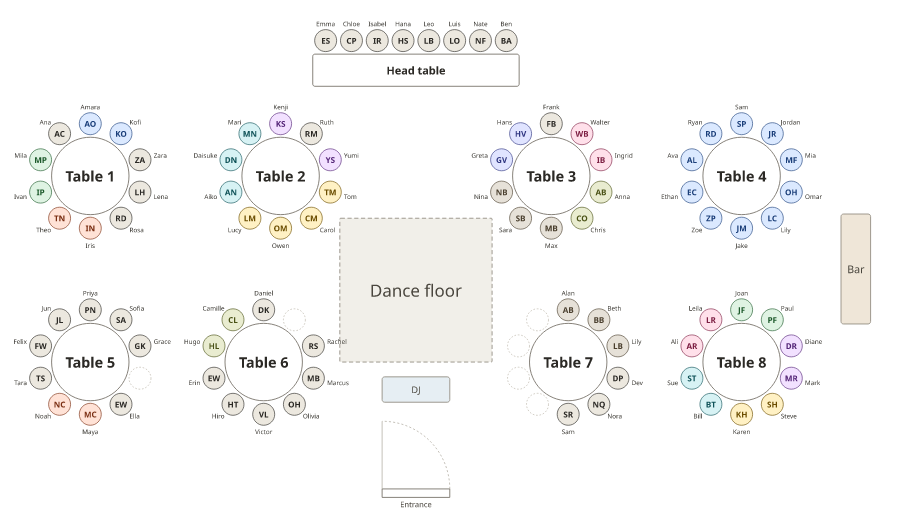
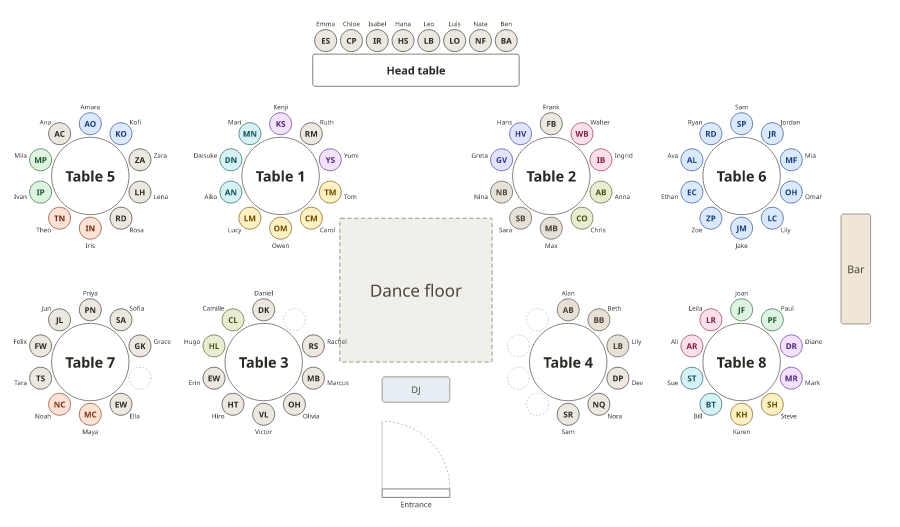
- Make numbers easy to see on stands taller than the centrepieces.
- Avoid gaps. If you leave out a number, tell the venue so nobody looks for a table that isn’t there.
- Named tables still need an order. If tables are named after places or songs, give staff the plan with numbers too.
In a seating chart generator, “Renumber tables by position” numbers the room in reading order, and you can change any table’s number or name. For names, see our table planner, which names every table from a list.
What the venue and caterer need
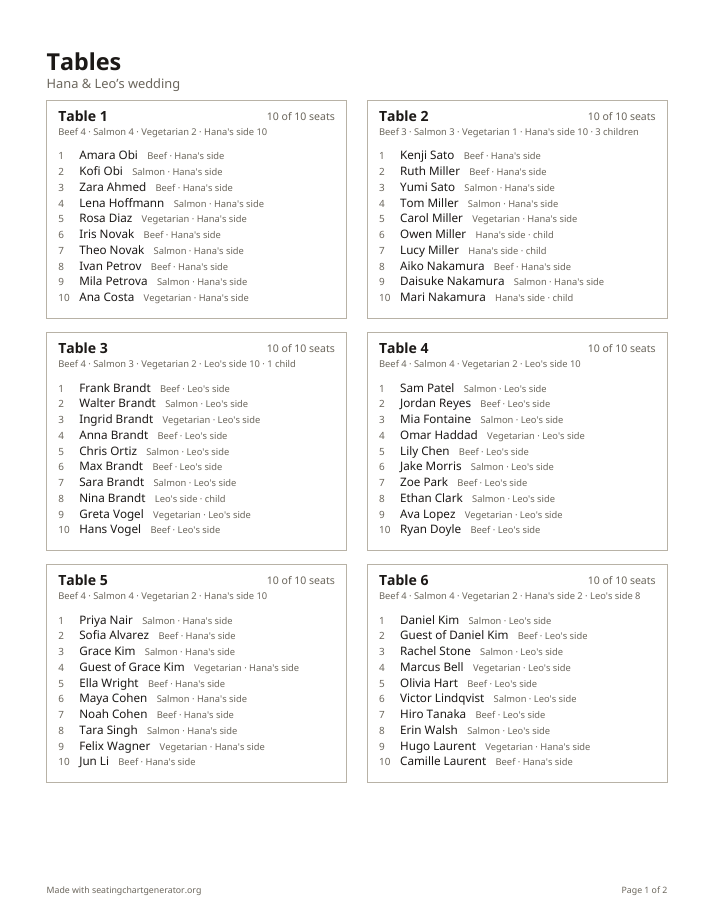
- The caterer: each table’s guests with their meal and any allergy, and a count of each meal per table.
- The venue: the floor plan with table numbers, and the total per table.
- Your planner or coordinator: an A–Z list of guests with their table, for anyone who can’t find their name on the day.
The easy way: a seating chart generator
- Paste your guest list from the spreadsheet. Households, sides, meals and plus-ones come across; guests who declined are left out.
- Add your tables, or keep the example room and change the number and size of tables.
- Set the few rules that matter: keep a family together, keep two people apart, seat a grandparent near you.
- Press Smart arrange to seat everyone, then drag anyone you want to move. Lock the head table so nothing moves it.
- Download the PDF: the floor plan, an A–Z list for the entrance and a list for each table with meal counts.
When the plan is done, the sign maker turns it into a board or a mirror sign, and our wedding seating chart ideas cover ways to display it.
Tips that save time
- Do the hardest tables first. The last few guests are easier to place once the difficult ones are settled.
- Keep one plan. Make changes in one place so the sign, the caterer’s lists and the venue’s plan always agree.
- Leave a seat or two free for a late reply or a plus-one who turns up.
- Check names once, at the source. A typo fixed in the plan is fixed everywhere.
- Keep a backup. Download the plan file and bring a printed A–Z list on the day.
Frequently asked questions
How long does it take to make a wedding seating chart?
With the guest list already in a spreadsheet, a first draft takes minutes in a seating chart generator. Most of the time goes into a few tricky tables and the last changes after the RSVP deadline.
When should we do the seating chart?
Start a draft once most replies are in, and finish it after your RSVP deadline. Ask your venue and caterer when they need the final numbers and the list for each table, and work back from that date.
Do we assign seats or just tables?
Assigning tables is the usual way: guests choose their own seat at their table. Exact seats make sense for the head table, a formal dinner, or when meals are served to a set place.
Should Table 1 be the one closest to the head table?
It is a common choice, and it tells family they are close to you. What matters most is that staff and guests can find tables easily, so pick one clear order and use it everywhere.
What is the easiest way to do a seating chart for a wedding?
Paste your guest list into a seating chart generator, set the few rules that matter (families together, two people apart), let it seat everyone, then adjust by hand. You can print the sign and the caterer’s lists from the same plan.
Where do we seat guests who don’t know anyone?
With people they have something in common with, such as age, work or a hobby, and at a table with outgoing guests. Avoid seating one person alone at a table of couples who all know each other.