How to make a wedding ceremony seating chart
- Set up the rows. Start from the example (ten rows of six on each side of the aisle) and change the rows and chairs to match your venue.
- Add your guests. Paste your guest list with each guest’s side and household, and tag close family.
- Reserve the front rows. Rules keep each side on its own rows and family in the front row; lock any chairs you are holding.
- Seat everyone. Press Smart arrange, or drag guests to chairs. Couples and families sit together.
- Print for the ushers. Download the PDF: the rows with names, an alphabetical list and a list for each row.
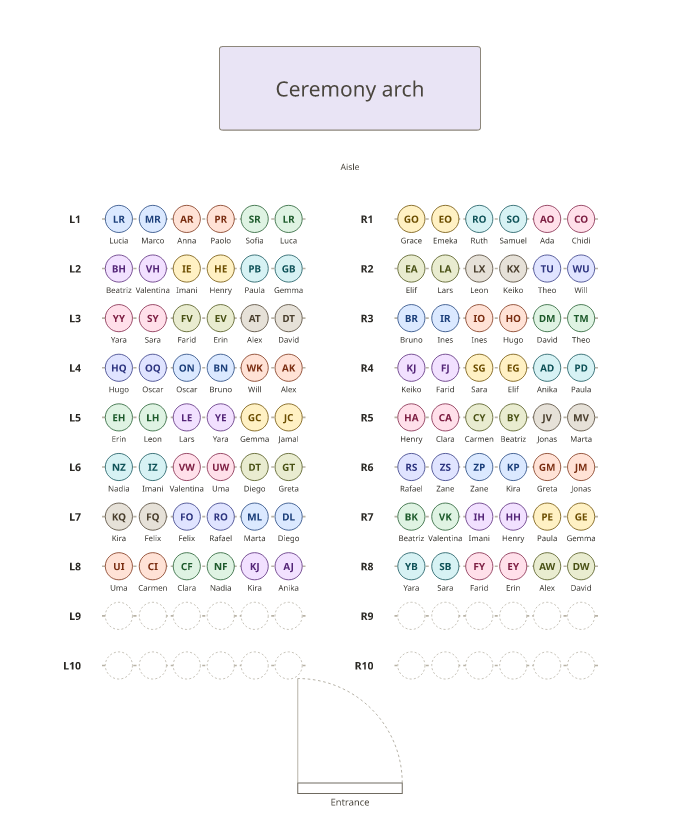
The chart above is a ceremony for 96 guests: ten rows of six chairs on each side of the aisle, facing the arch. Maya’s side sits on the left (rows L1 to L10), Daniel’s on the right (R1 to R10), and each family has the front row on its side. Rows 9 and 10 are spare. Switch to Wedding to plan the reception tables too.
Sides, front rows and reserved seats
- Sides. Traditionally each family sits on one side: at a Christian ceremony the bride’s on the left facing the altar, at a Jewish ceremony on the right. Tag each guest with their side and a rule keeps them on it.
- The front rows. Parents first, then grandparents and siblings. Tag them as family, and the example’s rule keeps family in row 1.
- Reserved and step-free seats. Lock a chair to hold it, and put guests who use a wheelchair or walker at the end of a row near the aisle.
- No sides at all. Delete the side rules: guests sit where they like and only the family rows are reserved.
Ceremony layouts
Straight rows with a center aisle suit most venues. For a smaller wedding, a semicircle brings everyone closer: use curved arcs of chairs (Add → Arc of chairs). Allow about 22 inches (55 cm) per chair, 3 feet (90 cm) from row to row, and an aisle of 4 to 6 feet. The chart is drawn to scale, so you can check the room size. For a church with fixed pews, see the seating protocol guide on reserved rows.
From the ceremony to the reception
The ceremony usually needs only the reserved rows; the reception needs a seat for everyone. Plan the tables in the wedding seating chart generator, make the sign with the seating chart sign maker, and read who sits where at the reception.
Wedding ceremony seating chart template
With names: Letter · A4 · Blank: Letter · A4
Frequently asked questions
Which side does the bride’s family sit on at the ceremony?
At a Christian ceremony, the bride’s family traditionally sits on the left, facing the altar, and the groom’s on the right. At a Jewish ceremony it’s the other way round. Many couples now skip sides altogether.
Who sits in the front rows at a wedding ceremony?
Parents in the first row on their side, then grandparents and siblings, then aunts, uncles and close friends. Keep an aisle seat for anyone who will walk in or read.
Do I need a seating chart for the ceremony?
Usually only for the reserved rows; other guests choose their seats. A chart helps the ushers when family is large, rows are tight, or some guests need step-free or aisle seats.
How many rows and chairs do I need?
Allow about 22 inches (55 cm) per chair and 3 feet (90 cm) from one row to the next, and keep the aisle 4 to 6 feet wide for the procession. 96 guests fit in ten rows of six on each side, with spares.
Can I seat both families on one side?
Yes. Remove the rules that keep each side on its rows, or tag everyone with one side; a “pick a seat, not a side” sign at the entrance tells guests to sit anywhere.
Is there a wedding ceremony seating chart template?
Yes. Download the PDFs below, with names or blank, or press Use this layout above to keep the rows and type your own guests.