Seating Protocol
Who sits where at an official dinner, a military function or a ceremony: the place of honour, the order of precedence at head and round tables, and the front row.
These are the conventions most protocol guides share. Official protocol varies by country, service and organisation, so for an official event the host’s protocol office has the final word.
Three rules
- The host is the reference point. Every place is described relative to the host: on their right, on their left, opposite.
- The place of honour is on the host’s right. The guest of honour sits there; with a co-host, the second guest of honour sits on the co-host’s right.
- Precedence decides the rest. The more senior the guest, the closer to the host, usually alternating right and left.
Working out precedence
- Military: by rank, and between people of the same rank usually by date of rank. A position, such as the commander of the unit hosting the event, can come first.
- Civilian officials: by the official order of precedence of their government, state or organisation.
- Foreign guests are placed by their position; their embassy or the protocol office can confirm the equivalent.
- When it isn’t clear, ask the protocol office before printing anything. Write the order down as a numbered list; the seating follows from it.
Head table
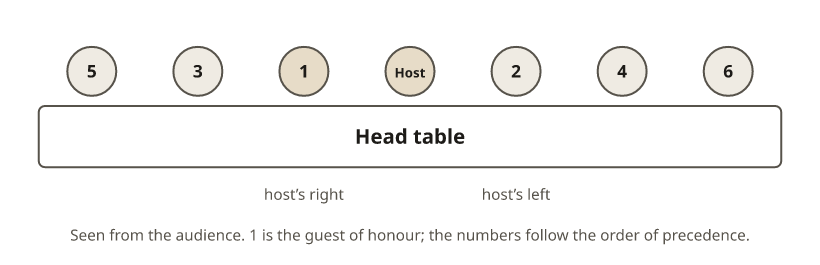
The host sits in the centre, facing the guests. The guest of honour (1) sits on the host’s right, the next most senior (2) on the host’s left, and the rest alternate outward. The host’s right is their own right as they face the room, so from the audience it’s on the left.
Round tables
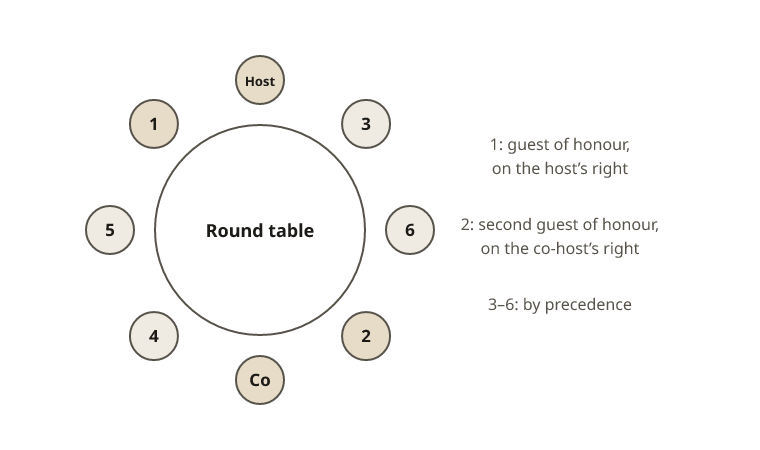
- Host and co-host sit opposite each other, at the ends of a long table or across a round one.
- The guests of honour sit on their right; the next most senior guests on their left.
- With several tables, the host’s table goes nearest the stage or the centre of the room, and each other table can have a senior person as its host.
Front row and ceremonies
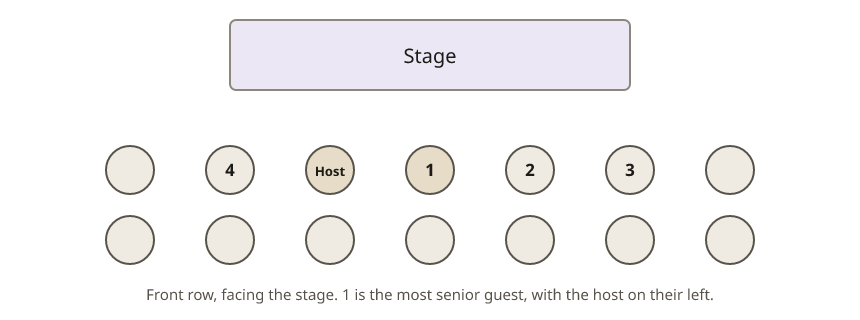
At a ceremony, a parade or a talk, the most senior guest sits in the centre of the front row, or in the seat nearest the centre aisle, with the host on their left. The next most senior guests sit outward on either side. Reserve the front rows with signs or cards, and give the ushers a list in seating order so they can show each guest to their place.
Spouses and partners
Spouses usually take the precedence of the person they accompany, unless they hold an official position of their own. Traditional formal dinners alternated men and women around the table; many current military and official guides seat by precedence regardless of gender. Follow the convention of the organisation hosting the event.
Making a protocol seating chart
- List every guest with their rank or position, and number the list in order of precedence.
- Place the host, then the guest of honour on the host’s right.
- Fill the head table or the host’s table, alternating right and left from the host.
- Assign the other tables by seniority, from the front of the room backwards.
- Make place cards with each guest’s correct title, and a reserved-seat list for the ushers.
- Have the protocol office check the chart before anything is printed.
In the generator, a tag such as “VIP” with a “Seat near” rule keeps senior guests close to the stage, and locked seats keep the head table exactly as you set it. The seating card maker prints place cards from the same plan. For general events, see our guide to making a seating chart; for weddings, wedding seating chart etiquette.
Frequently asked questions
Where does the guest of honour sit?
On the host’s right. With a co-host, the second guest of honour sits on the co-host’s right. Everyone else is seated by precedence.
Which side is the host’s right at a head table?
The host’s own right, as they sit facing the guests. Seen from the audience, that’s the left-hand side of the host. Mixing the two up is the most common mistake on a protocol seating chart.
How is precedence decided?
In the military, mainly by rank, and between people of the same rank usually by date of rank, though a position such as commander can come first. Civilian officials follow their government’s order of precedence. When in doubt, ask the host’s protocol office.
Where do spouses sit at an official dinner?
Spouses usually take the precedence of the person they accompany, unless they hold an official position of their own. They can sit beside their partner or be placed by that precedence elsewhere at the table.
Where does the most senior guest sit at a ceremony?
In the centre of the front row, or the seat nearest the centre aisle, with the host on their left. The next most senior guests sit outward on either side.
Is there a standard military seating protocol chart?
There’s no single template. Each service and organisation has its own guidance, for example the US Army’s guide to protocol and etiquette for official entertainment (DA Pam 600-60). Build the chart from your precedence list using the patterns on this page, then have the protocol office check it.