Seating Plan or Sitting Plan?
Which one is correct, what seating chart, seating plan and seating arrangement mean, how escort cards and place cards differ, and what to call it in Spanish and French.
The short answer
“Seating plan” is correct. A seating plan is a drawing or a list that shows where each person will sit, at a wedding, a dinner, a meeting or in a classroom. “Sitting plan” is a common slip that dictionaries don’t list, so use “seating plan” on anything you print. In the US the same thing is usually called a seating chart.
Why “seating”, not “sitting”
- Sitting is what you do: “She’s sitting at Table 4.”
- Seating is the seats and the way they’re arranged: “seating for 120”, “the seating at the reception”.
- A sitting is also a time when a meal is served to one group of people, when there isn’t room for everyone at once: “dinner is served in two sittings”. So a “sitting plan” sounds like a timetable for meals, not a plan of who sits where.
An easy way to remember it: you sit on the seating.
Seating chart, seating plan and seating arrangement
- Seating chart
- A plan of the room, or a list, with each person’s name at their table or seat. The usual term in the US, for weddings and classrooms alike.
- Seating plan
- The same thing. The usual term in British English.
- Seating arrangement
- Either the way the seats are laid out (rows, a U-shape, round tables) or who sits where. “Let’s change the seating arrangement” can mean moving the furniture or moving the people.
- Floor plan or layout
- Where the tables, stage, doors and dance floor go, with no names.
In a classroom
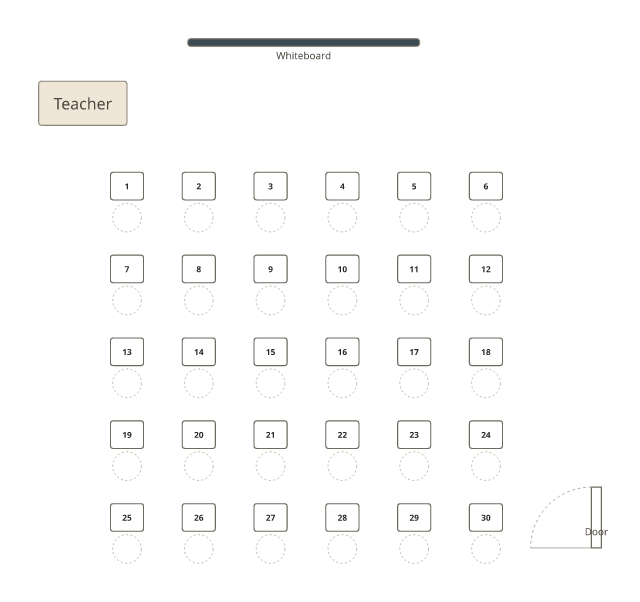
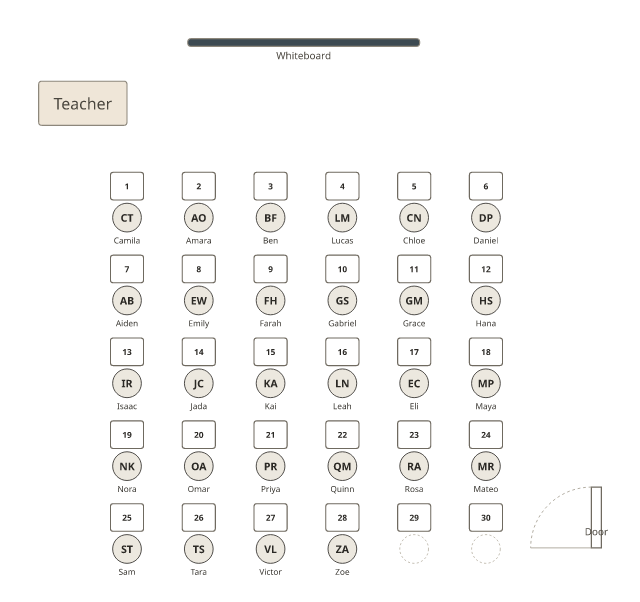
A classroom seating arrangement is the way the desks are set out (rows, pairs, groups, a U-shape) and which student sits at each one. Teachers use it to keep attention on the front, to sit students who work well together side by side, to keep students who distract each other apart, and to learn names quickly. Written down, with names at the desks, it’s the classroom seating chart, which is also what a substitute teacher uses to take attendance.
Our classroom seating arrangement ideas show seven layouts with diagrams, and the classroom seating chart generator makes the chart from your class list.
Seating chart, escort cards and place cards
| Option | What it is | Where it goes | Tells the guest |
|---|---|---|---|
| Seating chart | One board or list with every guest and their table | Near the entrance | Their table |
| Escort cards | A card for each guest or couple, with their name and table | On a table near the entrance; guests take theirs | Their table |
| Place cards | A card with a guest’s name | At their place on the table | Their seat |
- A seating chart or escort cards: they do the same job, so most weddings choose one.
- Place cards are an extra for exact seats: a head table, a formal dinner, or a plated meal where the card shows each guest’s meal to the servers. Guests still need a chart or escort cards to find the table.
- Use one list for all of them, so the chart, the cards and the caterer’s copy agree.
For the full process, see how to make a wedding seating chart; for ways to display it, our wedding seating chart ideas.
In Spanish
Spanish has no single fixed term. You’ll see:
- distribución de los asientos: the seating plan or seating arrangement in general.
- distribución de los invitados: how the guests are seated at a wedding or an event.
- mapa de asientos: a seating chart drawn as a map, a name often used for seating chart templates.
Some wedding guides in Spain borrow the English words, with a twist: el seating is how the guests are spread across the tables, and el sitting is the small card with a guest’s name at their place, what English calls a place card.
In French
- plan de table: the seating plan at a wedding or a dinner, placing each guest at a table.
- plan de classe: a classroom seating chart, fixing each student’s place in the room.
- placement libre: open seating, where guests sit where they like.
Frequently asked questions
Is it sitting plan or seating plan?
Seating plan. “Sitting” is the act of being in a seat; “seating” means the seats and the way they are arranged. Dictionaries list “seating plan”, and “sitting plan” is a common slip, so use “seating plan” on anything you print.
What is a seating chart?
A plan or list that shows where each person sits, by table or by seat, at a wedding, a dinner, an event or in a classroom. It is usually a drawing of the room with names, an alphabetical list with table numbers, or a sign at the entrance.
Is a seating chart the same as a seating arrangement?
Nearly. A seating arrangement is how the seats are laid out, or who sits where; the seating chart is that arrangement written down with names, so people can find their place.
What is the difference between a seating chart and escort cards?
They do the same job in different forms. A seating chart is one board or list with every guest’s table; escort cards are one card per guest (or couple) with their name and table number, set out near the entrance. Most weddings use one or the other.
Do I need place cards if I have a seating chart?
Only if you assign exact seats, for example at a head table, a formal dinner or a plated meal where the card shows each guest’s meal to the servers. If guests choose their own seat at their table, the seating chart is enough.
How do you say seating chart in Spanish and French?
In Spanish, “distribución de los asientos” for a seating plan in general, or “mapa de asientos” for a chart drawn as a map. In French, “plan de table” for a wedding or dinner and “plan de classe” for a classroom.