Classroom Seating Arrangement Research
What studies have found about rows, groups and semicircles, where students sit, and using seating to help students get on, with the full references.
A summary of well-known studies on classroom seating, written for teachers and for students preparing a review of related literature. Each study is small and specific, so read the findings as evidence, not rules. Full references are at the end.
The short version
- Match the layout to the task. A review of eight studies concluded that no single arrangement is best for every task (Wannarka and Ruhl, 2008).
- Individual work: students stayed on task more in rows than around tables, and the most easily distracted students gained the most (Wheldall and others, 1981; Hastings and Schwieso, 1995).
- Discussion: children asked more questions in a semicircle than in rows (Marx, Fuhrer and Hartig, 1999).
- Seat location: students at the front and centre take part more. Whether front seats raise grades is disputed (Perkins and Wieman, 2005; Kalinowski and Taper, 2007).
- Relationships: seating children who disliked each other closer together for several weeks improved how they were seen by classmates (van den Berg, Segers and Cillessen, 2012).
Rows or groups?
Wheldall, Morris, Vaughan and Ng (1981) observed two classes of 10 and 11 year olds who sat around tables for two weeks, in rows for two weeks, and around tables again. On-task behaviour was higher in rows and fell when the classes went back to tables. The effect was strongest for children who were least on task to begin with; for children who were already on task, the layout made little difference.
Hastings and Schwieso (1995) studied primary classrooms and found more time spent on individual tasks when children were not seated in groups, again with the biggest gains for the most distractible children. Hastings later stressed that the point isn’t a return to rows: what matters for individual work is that children aren’t sitting opposite each other, and a horseshoe or other layout can do that too.
Wannarka and Ruhl (2008) reviewed eight studies comparing rows, groups and semicircles. They found that students behave better during individual tasks in rows, that disruptive students benefit most, and that the nature of the task should decide the arrangement.
Semicircles and questions
Marx, Fuhrer and Hartig (1999) seated fourth graders in a semicircle and in rows for two weeks each, over 53 lessons. Children asked more questions in the semicircle. The authors linked this to face-to-face contact, which makes it easier to join in, and cautioned that the teacher’s style also matters.
The action zone
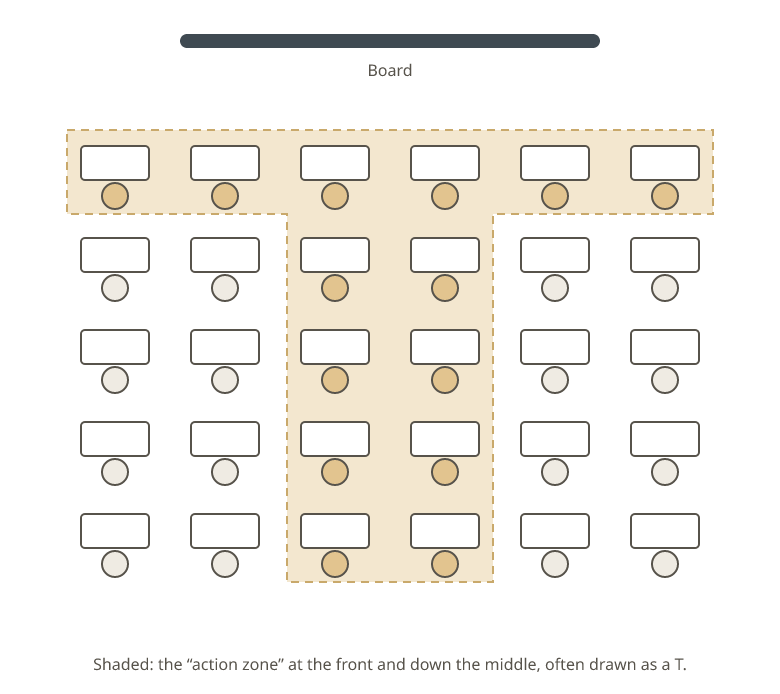
In a room set out in rows, the students who take part most tend to sit at the front and down the middle, an area often called the action zone and drawn as a T. Marx and colleagues found such a zone in their row arrangement: children seated there asked more questions per lesson. It’s one reason to move students around during the year rather than leave the same ones at the back.
Does sitting at the front raise grades?
Perkins and Wieman (2005) randomly assigned seats in a large introductory physics course. Students seated at the front earned better grades, attended more and had better attitudes to physics, and moving seats halfway through the term didn’t undo the effect.
Kalinowski and Taper (2007) repeated the idea with randomly assigned seats in an introductory biology class and found that sitting at the back did not lower exam grades. Taken together, seat location may matter in some classes but isn’t a reliable lever on its own.
Seating and how students get on
Van den Berg, Segers and Cillessen (2012) ran a field experiment with 651 children aged 10 to 12 in 27 classrooms. In the experimental classrooms, children who didn’t like each other were seated closer together for several weeks. The children who were least liked at the start of the year were rated more likeable afterwards, and peer reports of victimisation and social withdrawal fell. Seating can be a tool for relationships, not only behaviour, though it needs care and watching.
What this means in practice
- Choose by task: rows or a horseshoe for tests and individual work, groups for collaboration, a semicircle for discussion.
- For individual work, avoid seating easily distracted students face to face with classmates.
- Rotate seats so different students get time in the front and centre.
- Seat for needs first: students who need to see or hear well, then everyone else.
- Use seating for relationships deliberately, and keep watching how new neighbours get on.
Pros and cons by layout
| Layout | Pros | Cons |
|---|---|---|
| Rows | More on-task behaviour in individual work; easy to keep students apart | Less discussion; participation concentrates at the front and centre |
| Groups | Natural for collaboration and shared materials | More off-task talk during individual work, especially for distractible students |
| Semicircle or horseshoe | Everyone sees everyone; more questions and discussion | Takes more wall space; harder in large classes |
For diagrams of each layout and how many desks they need, see our classroom seating arrangement ideas.
References
- Hastings and Schwieso (1995). Tasks and tables: The effects of seating arrangements on task engagement in primary classrooms. Educational Research, 37(3), 279–291.
- Kalinowski and Taper (2007). The effect of seat location on exam grades and student perceptions in an introductory biology class. Journal of College Science Teaching, 54–57.
- Marx, Fuhrer and Hartig (1999). Effects of classroom seating arrangements on children’s question-asking. Learning Environments Research, 2, 249–263.
- Perkins and Wieman (2005). The surprising impact of seat location on student performance. The Physics Teacher, 43(1), 30–33.
- Van den Berg, Segers and Cillessen (2012). Changing peer perceptions and victimization through classroom arrangements: A field experiment. Journal of Abnormal Child Psychology, 40, 403–412.
- Wannarka and Ruhl (2008). Seating arrangements that promote positive academic and behavioural outcomes: A review of empirical research. Support for Learning, 23(2), 89–93.
- Wheldall, Morris, Vaughan and Ng (1981). Rows versus tables: An example of the use of behavioural ecology in two classes of eleven-year-old children. Educational Psychology, 1(2), 171–184.
Frequently asked questions
What does research say about classroom seating arrangements?
That the task should decide the layout. Rows help students stay on task during individual work, especially easily distracted students; semicircles and groups support discussion and questions. No single arrangement is best for everything.
Are rows better than groups?
For individual work, studies have found more on-task behaviour when students sit in rows than around tables. For collaborative work, groups make more sense. The key for individual work is that students don’t sit facing each other.
Does sitting at the front improve grades?
The evidence is mixed. One physics course with randomly assigned seats found better grades at the front, but a later study with randomly assigned seats in a biology course found no difference.
What should a classroom seating arrangement be based on?
The activity first, then the students: who needs to see or hear well, who distracts whom, who works well together, and how students get on with each other. Change the arrangement when the task changes.
What is the action zone in a classroom?
The front and centre of a room in rows, often drawn as a T, where students tend to take part more. Studies have found more questions and interaction from students seated there.
What are the benefits of teaching in a circle or semicircle?
Everyone can see everyone else, which supports discussion. In one study of fourth graders, children asked more questions when seated in a semicircle than in rows.